---
title: "Claude Opus 4.8 in the Real World: What It Means for Small Business Owners"
description: "Anthropic just shipped Claude Opus 4.8. We put it to work on a real client website and a live iOS app. Here's what it means for small business owners."
date: "2026-05-29T07:00:00-07:00"
category: "AI & Growth"
author: "Enzo Sison"
image: "/blog/claude-opus-4-8-what-it-means-for-small-business-owners.png"
gradientClass: "bg-gradient-to-br from-amber-300/30 via-rose-300/30 to-violet-300/30"
openGraph:
title: "Claude Opus 4.8 in the Real World: What It Means for Small Business Owners"
description: "Anthropic just shipped Claude Opus 4.8. We put it to work on a real client website and a live iOS app. Here's what it means for small business owners."
url: "https://www.design-prism.com/blog/claude-opus-4-8-what-it-means-for-small-business-owners"
siteName: prism
images:
- url: "https://www.design-prism.com/blog/claude-opus-4-8-what-it-means-for-small-business-owners.png"
width: 1200
height: 630
alt: "Claude Opus 4.8 tested on a real client website and iOS app"
locale: en_US
type: article
publishedTime: "2026-05-29T15:00:00.000Z"
authors:
- Enzo Sison
twitter:
card: summary_large_image
title: "Claude Opus 4.8 for small business owners"
description: "We put Claude Opus 4.8 to work on a real client website and a live iOS app on launch day. Here's the honest takeaway for founders."
images:
- "https://www.design-prism.com/blog/claude-opus-4-8-what-it-means-for-small-business-owners.png"
canonical: "https://www.design-prism.com/blog/claude-opus-4-8-what-it-means-for-small-business-owners"
seoTitle: "Claude Opus 4.8 for small business owners"
seoDescription: "Anthropic shipped Claude Opus 4.8. We put it to work on a real client website and a live iOS app. Here's what it means for owners."
---
import YouTubeVideoEmbed from "@/components/youtube-video-embed"
import { VideoObjectSchema } from "@/components/schema-markup"
*By Enzo Sison, Founder of Prism*
Anthropic shipped [**Claude Opus 4.8**](https://www.anthropic.com/news/claude-opus-4-8) this morning. The benchmarks are great, the early-access crowd is loud. But if you run a dental practice, a med spa, or a home-services company, none of that tells you the only thing you actually care about:
**does this change what I can get built for my business, and how fast?**
So instead of talking about it, I recorded myself using it. On launch day, with no early access, I put Opus 4.8 to work on two real things we ship at Prism: a **live client website redesign** and **new features inside Marble**, our iOS workout app that's been on the App Store since February.
Here's the session, then the takeaways that matter for a business owner, not an engineer.
## First, What Is Claude Opus 4.8, and Why Should an Owner Care?
Opus 4.8 is Anthropic's newest top-tier AI model. The reason it matters to you isn't the leaderboard. It's that each of these jumps quietly raises the floor on what a small team (or a one-person shop with the right partner) can produce.
A year ago, "AI-built website" meant a generic, slightly-off template you could spot from a mile away. That era is over. What I saw on launch day was premium, on-brand work that I'd happily put in front of a paying client. That shift is the whole story for small businesses.
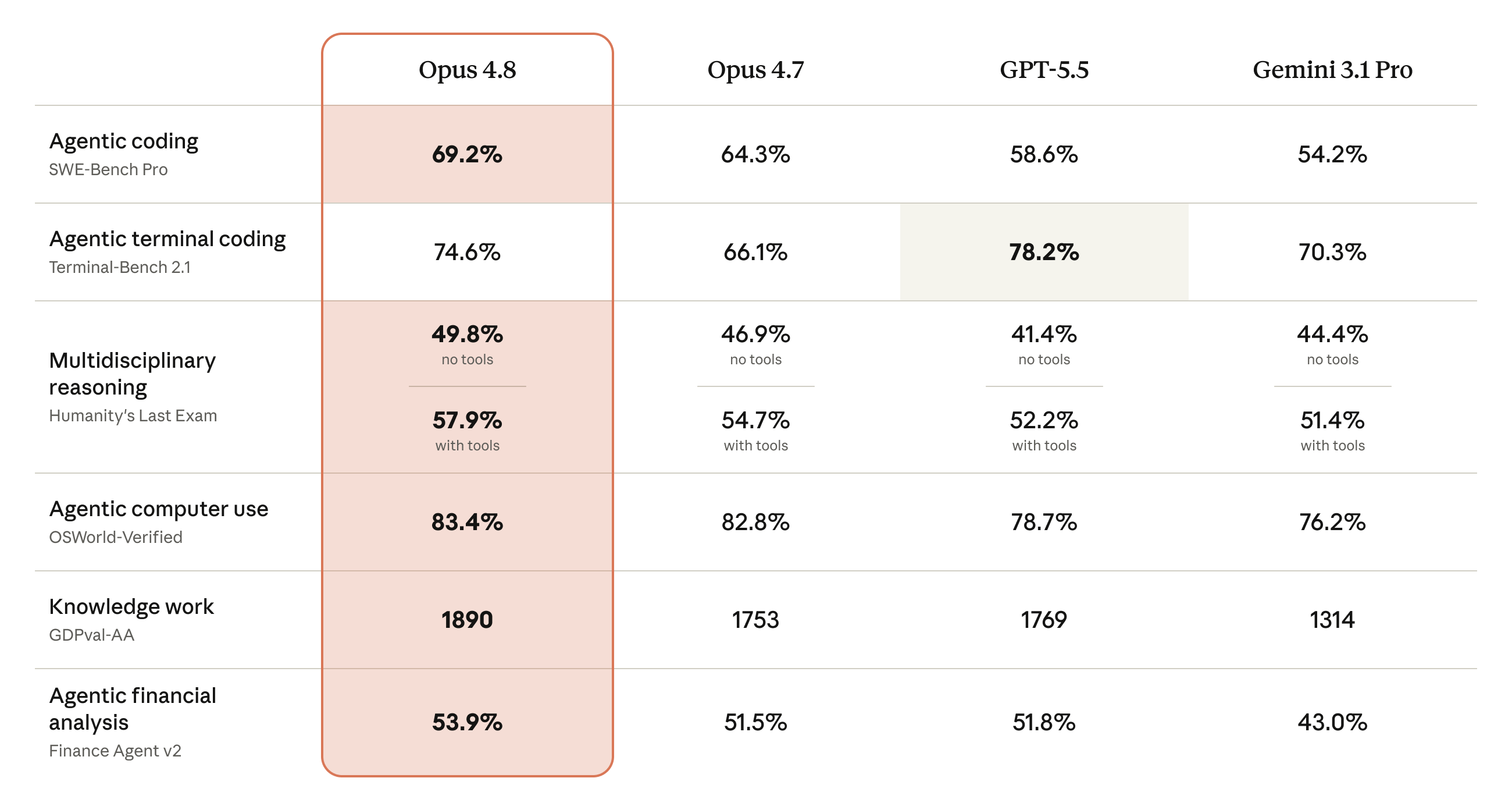
According to [Anthropic's own announcement](https://www.anthropic.com/news/claude-opus-4-8), Opus 4.8 sets new records across coding, agentic, and knowledge-work tasks. Here's their published comparison against the previous Opus and the other frontier models:
Opus 4.8 vs. Opus 4.7, GPT‑5.5, and Gemini 3.1 Pro on Anthropic's published benchmarks. Source: Anthropic: Introducing Claude Opus 4.8.
You don't need to memorize those numbers. Here's the plain-English read for a business owner: on **real-world coding** (SWE-Bench Pro, fixing actual bugs in a real codebase, which is exactly what building your website or app is), Opus 4.8 jumps to **69.2%**, ahead of every other model on the chart. It also leads on agentic computer use, multidisciplinary reasoning, and knowledge work. The one row where a competitor wins is raw terminal coding, where GPT‑5.5 edges ahead. Translation: **the AI doing your project is now measurably the best in the world at the kind of messy, multi-step, real-codebase work your website and app actually require.**
Two more things worth knowing, because they affect what you can ask for:
- **It's the same price as the last version.** Anthropic kept Opus 4.8 at $5 per million input tokens and $25 per million output tokens, so you get a meaningfully better model without a price hike (there's also a faster "Fast mode" for time-sensitive work).
- **It plugs into [Claude Code](https://www.anthropic.com/product/claude-code)**, Anthropic's agentic coding system, the tool I'm actually driving in the video. Alongside 4.8, they shipped *Dynamic Workflows*, which lets Claude Code run many sub-tasks in parallel. For you, that's the difference between "redesign one page" and "redesign and wire up the whole site" in a single session.
## Case Study 1: Rebuilding a Real Client Website
The first thing I tested was a redesign for a **periodontist client**. Their current site is built the "OG" way: Webflow, Figma, and Relume components, stitched together with some external icon kits and a JotForm embed for booking. It's a solid, clean, minimalist site. Lots of white space, a premium feel, a few scroll-reveal animations. Nothing wrong with it. Just… average-good.
Then I ran the redesign through [**Claude Code**](https://www.anthropic.com/product/claude-code) on Opus 4.8, on its highest reasoning mode, and the difference was night and day.
A few things stood out immediately:
- **A full-screen video hero.** It took the practice's video and built it into a true full-bleed hero section, the kind of thing that used to require a designer and a front-end dev working together.
- **Custom hover states and icons it sourced on its own.** Some of the icons I wanted weren't on the original site, so Claude went and found appropriate ones and wired up clean, premium hover animations. I didn't hand it those assets.
- **Real multi-page structure, not a one-page demo.** It built out dedicated service pages (a *tissue grafting* page, a *meet the dentist* page), each laid out far better than the originals, with a sticky side feature that stays put as you scroll.
- **Genuinely responsive.** Dragged down to mobile, the nav bar, logo, and footer all looked clean and intentional. No broken middle-width breakpoints.
And to be clear: **this was not one-shot.** It took a few iterations and direction from me. That's not a knock. It's the most important lesson in this whole post (more on that below).
### The Lesson: AI Design Quality Just Crossed a Threshold
We've officially graduated past the "you can tell a robot made this" phase. The typography felt intentional, the spacing was clean, the components actually belonged together. For an owner, that means the gap between "I can't afford a premium website" and "I have a premium website" just got dramatically smaller.
### The Quieter Win: Internal Linking and Per-Service Pages (a.k.a. SEO)
The part that's easy to miss in the video is the **internal linking** between all those new service pages. That's not just polish. It's how Google and AI search engines understand what your business does and which pages to rank.
When every service gets its own well-linked page ("dental implants," "tissue grafting," "gum recession"), you give search engines far more surface area to find you. A single homepage can't do that. This is one of the highest-leverage, least-glamorous things a small business site can get right, and the redesign nailed it almost for free.
## Case Study 2: Shipping App Features in an Afternoon
The second test was **Marble**, an iOS workout app I've been building for people who are serious about lifting. It's been live on the App Store since February, and I use it in the gym every single day. That creates an unusually tight feedback loop: I hit a paper-cut in the UX during my workout, then have Claude fix it the same day.
On launch day, Opus 4.8 built an entire **gamification system** into the app:
- A **progression currency** you earn as you work out and spend on unlocks, themed around a "Greek golden age" aesthetic, and the design came out genuinely beautiful.
- An upgrade to our existing **streaks** feature, adding a daily bonus you can claim for logging a workout every day.
- It even handled **dark mode** and ran its own tests against the build.
The thing I want owners to notice: Opus 4.8 didn't reinvent the app. It **built on the existing design system** and pushed it forward. That's the difference between an AI that makes a mess and one that respects the brand you've already built.
### The Lesson for Local Businesses: Retention Is Now Affordable
You might not be shipping an iOS app. But "currency, streaks, and progression" is just the app version of a **loyalty program**, the thing that turns a one-time customer into a regular. Punch cards, points, referral perks, "your 5th cleaning is free." Features that used to require custom software and a real budget are now a same-day build. Acquisition gets you customers; mechanics like these are what keep them.
## The Honest Part: Speed, Cost, and Where Humans Still Win
I won't oversell it. Three honest notes from the day:
1. **It's not free, and heavy use adds up.** I'm on maxed-out plans and still burning through usage limits. Frontier AI is cheap compared to a dev team, but it's not magic-free.
2. **It's slower at the very top reasoning setting**, and worth it for design-quality work, which is exactly the tradeoff founders know well: ship fast, or ship clean. We're getting closer to both.
3. **Taste and iteration still come from a human.** The website wasn't one-shot. The app features needed me to notice the problem first. The model is an extraordinary executor. It is not your strategist, your brand, or your customer.
For the record: I think 4.8 is a clear step up from 4.7, and [Anthropic's published benchmarks](https://www.anthropic.com/news/claude-opus-4-8) back that up, with Opus 4.8 leading on real-world coding, reasoning, computer use, and knowledge work. The one spot a rival still wins is raw terminal coding, where GPT‑5.5 comes out ahead. Day to day, though, I'm enjoying 4.8 more than GPT‑5.5, and now I'm just curious how OpenAI answers.
## What This Actually Means for Your Business
If you take one thing from launch day, take this: **the bar for "premium" just dropped, which means your competitors can clear it too.** Here's the practical move:
- **Audit your website against this new bar.** If it looks like a 2022 template, it's now visibly behind, and it's fixable faster and cheaper than you think.
- **Give every service its own page** and link them together. This is the single best SEO investment most local businesses are ignoring.
- **Add one retention mechanic** this quarter: a loyalty perk, a referral incentive, a follow-up flow. Acquisition is loud; retention is where the margin lives.
- **Use AI for the first draft, and a pro for the last 30%.** AI gets you 70% of the way fast. The final stretch (trust, a clear 5-second offer, a frictionless booking flow, working tracking) is where leads are won or lost.
## Bottom Line
Claude Opus 4.8 is the real deal, and you don't have to be a developer to benefit from it. The same model that redesigned a client's website and shipped app features in an afternoon can absolutely build you a site that gets found, earns trust, and turns visitors into booked appointments.
The catch is that the *output* is only as good as the *taste and strategy* behind it. That's the part we obsess over.
If you want a website and growth system built on this new bar (premium design, real SEO structure, and the retention mechanics that keep customers coming back), [join the Prism waitlist](https://www.design-prism.com/waitlist) and we'll map it out with you when we can take on your team.
## Sources & Further Reading
- [Introducing Claude Opus 4.8, Anthropic](https://www.anthropic.com/news/claude-opus-4-8) (official announcement + benchmarks)
- [Claude Opus, Anthropic](https://www.anthropic.com/claude/opus) (model overview and pricing)
- [Claude Code, Anthropic](https://www.anthropic.com/product/claude-code) (the agentic coding system used in the video)